
How to Search Worcester County Traffic Court Records
Traffic cases in Worcester County are searched online through MassCourts, the public eAccess system run by the Massachusetts Trial Court. Civil motor-vehicle citations and criminal motor-vehicle complaints are District Court matters, so you search the District Court department and the right Worcester County division. A docket or citation number gives the cleanest result. If you do not have one, a party name works, but common names return long lists. Knowing the rough date and the division helps you narrow fast.
Pick the division that matches where the ticket was issued. Worcester County has several District Court divisions, and a case from Fitchburg will not show up under the Worcester division. Have your citation in hand if you can. The number on it is the fastest way to pull the matching court file.
- Open the MassCourts eAccess portal and choose the District Court department.
- Select the Worcester County division tied to the citation location.
- Enter the docket or citation number when you have it.
- If you do not, search by last name and narrow by date range.
- Open the case summary and read the docket entries.
- Check the finding, the fine, and any default or warrant note.
- Ask the clerk's office for a certified copy or for older files not shown online.
The main citation search fields on the public portal are listed below. Run a live lookup on the MassCourts eAccess portal, and use the Mass.gov dockets and calendars hub for daily court lists.
| Field | Required | Notes |
|---|---|---|
| Court Department | Yes | District Court. |
| Division | Yes | Worcester County District Court division. |
| Docket / Citation Number | Optional, best | Use the citation or docket number when known. |
| Last Name | Optional | Party search. |
| Date Range | Optional | Narrows the filing or hearing search. |
The District Court department page explains how the division system works and what kinds of cases each court hears. A quick look there makes the division-first search easier to follow. See the Massachusetts District Court department page for the full setup.
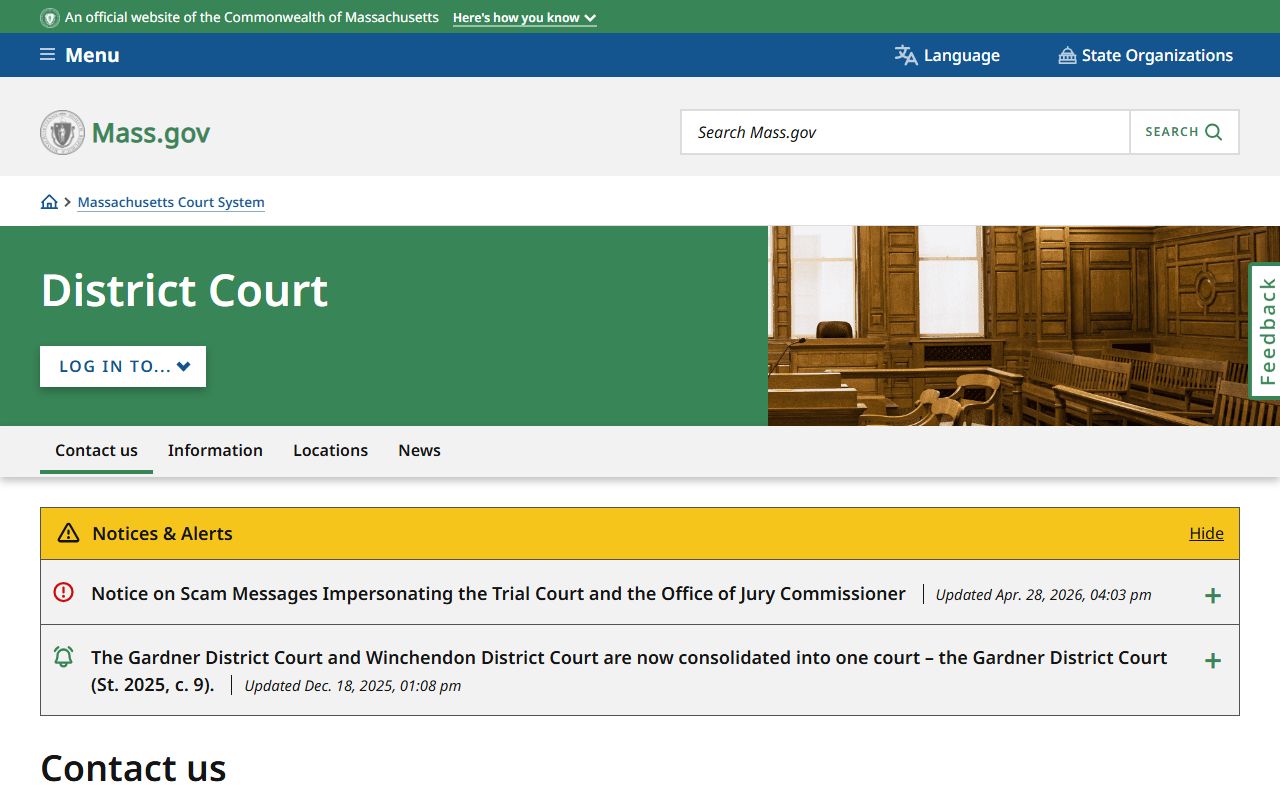
The page links out to each Worcester County division and to the public case-search tools, which keeps a traffic search from starting in the wrong court.
Which Courts Handle Traffic Cases in Worcester County
Traffic and motor-vehicle cases in Worcester County are heard in the District Court division for the place where the citation or complaint was filed. Massachusetts does not run one countywide traffic court. Instead, the case follows the division that covers the town or road where the stop happened. That is why the division you pick on the portal matters so much.
Worcester County has many District Court divisions spread across the region. A ticket near downtown maps to the Worcester division, while one in the north county may map to Fitchburg, Leominster, or Gardner. Other divisions serve their own local areas. The list below shows the Worcester County District Court divisions that may hold a traffic file.
- Worcester
- Fitchburg and Leominster
- Gardner and Clinton
- Dudley and Milford
- Uxbridge, Westborough, and East Brookfield
Serious motor-vehicle crimes can also reach the Superior Court, but the day-to-day traffic docket lives in District Court. For the wider court layout, the Worcester County District Court page lists each division, and the court records page covers the broader search steps.
Types of Traffic Cases on Record
Worcester County traffic court records split into two broad groups. Civil motor-vehicle infractions are the common tickets: speeding, a stop-sign violation, or a similar minor offense. These are decided on a responsible or not responsible finding, not guilt. Criminal motor-vehicle offenses are more serious and carry the chance of a record and jail. Both kinds can show up in District Court files.
The mix of charges that appear in these records is wide. Some are paid and closed quickly. Others run through a hearing or a trial. The most common case types found in Worcester County traffic court records include the following.
- Civil motor-vehicle citations, such as speeding or signal violations
- Operating after a license suspension or revocation
- Negligent or reckless operation
- OUI and DUI-type motor-vehicle charges
- Criminal motor-vehicle complaints filed by police or a clerk-magistrate
A civil ticket and a criminal complaint are handled in different ways. The civil ticket ends in a money finding. The criminal complaint can end in a plea, a trial, or a dismissal, and it may carry license and custody consequences.
What Worcester County Traffic Court Records Show
A traffic court record is built from a set of standard fields. The case summary names the party, the court, and the case type. The docket lists each event in order, from the citation or complaint to the finding. Money fields show the fine, any assessment, and whether it was paid. A missed hearing or unpaid fine can show as a default, and a default may lead to a warrant. Some data is masked, such as identifying numbers and protected details.
| Field | What It Shows |
|---|---|
| Docket / Citation Number | Court identifier tied to the ticket or complaint. |
| Court Division | The Worcester County District Court location handling the case. |
| Party / Defendant | The named driver, or the Commonwealth and defendant. |
| Charge or Citation | The motor-vehicle offense that started the case. |
| Hearing Date | Date set for a hearing or court event. |
| Finding / Disposition | Responsible, not responsible, or a criminal outcome. |
| Fine and Fees | Amount owed, paid, or assessed. |
| Default / Warrant | Note when a hearing was missed or a fine went unpaid. |
A search result is not a certified copy. For court use, ask the clerk of the division where the case was filed for a certified docket or finding.
Searching by Citation Number vs by Name
There are two main ways to find a Worcester County traffic case. You can search by the citation or docket number, or you can search by name. Each path has trade-offs. The number is exact and pulls one file. The name is broader and may return many results, which then need to be sorted by date and division.
Use the citation number when you have the ticket in front of you. It is printed on the citation and ties straight to the court file. The number search skips the guesswork and lands on the right record fast. This is the cleaner path when you know the case exists.
Use a name search when the citation is lost or when you are checking whether a case exists at all. A name plus a date range and the right division narrows a long list. Keep in mind that a common name can match many people, so confirm the party details before you act on a result. When in doubt, the clerk's office can match a name to the correct docket.
Paying or Contesting a Worcester County Traffic Ticket
What you do with a ticket depends on the type. A civil motor-vehicle citation has a deadline and a set of choices: pay it, ask for a clerk-magistrate hearing, or appeal a finding. A criminal motor-vehicle complaint is different, and you must appear in District Court as ordered. Read the citation closely, because it states the deadline and the steps. Missing the deadline can add costs and trigger a default.
The steps below walk through how a Worcester County traffic ticket is paid or contested. They follow the official citation, RMV, and court process.
- Read the citation instructions and note the deadline.
- Decide whether the matter is civil or criminal.
- Pay, appeal, or request a hearing through the official citation, RMV, or court process.
- For criminal motor-vehicle charges, appear in the Worcester County District Court as ordered.
- If you miss a hearing or fail to pay, expect defaults, warrants, late fees, or license consequences.
- CDL holders should get legal advice, since commercial-driver reporting can differ.
Note: A default for a missed hearing or unpaid fine can lead to a warrant and to license action, so handle a citation before its deadline.
Public Access Laws for Traffic Court Records
Massachusetts splits access into two systems. The Public Records Law covers state and local agencies. Court case files, including traffic dockets, follow a separate set of Trial Court rules, statutes, and impoundment orders. So a request for an agency policy goes through the Public Records Law, while a request for a certified traffic docket goes to the court clerk under court-record rules. Trial Court Rule XIV is the main rule for public access to court records.
Key Statutes:
Massachusetts General Laws c. 66, § 10 - sets the public right to request agency records and the response steps.
Trial Court Rule XIV - governs public access to Trial Court case records, including traffic files.
Massachusetts General Laws c. 4, § 7, cl. 26 - defines public records and lists the exemptions.
More on agency requests, fees, and appeals to the Supervisor of Records is on the Worcester County public records page.
Court Traffic Records vs State Driver Records
This is the point that trips up most people. The court traffic record and the state driver record are two different files. The court file lives with the District Court and shows the citation, hearing, finding, and fine. The driver record lives with the Massachusetts Registry of Motor Vehicles and shows license status, convictions, suspensions, and surcharge history. You may need one, the other, or both, depending on your goal.
Use the comparison below to tell the two apart before you search. The court record answers what happened in a case. The driver record answers what shape your license is in.
| Category | Court Traffic Record | RMV Driver Record |
|---|---|---|
| Maintained by | District Court / Trial Court | Massachusetts Registry of Motor Vehicles |
| Search path | MassCourts eAccess or the court clerk | RMV driving-record request |
| What it shows | Citation or complaint, hearing date, finding, fine, default or warrant, docket events | License status, convictions, suspensions, surcharge and points history |
| Certified by | Court clerk | RMV |
| Public access | Court rules and restrictions apply | Identity and payment rules apply |
The Massachusetts Registry of Motor Vehicles page is the right place to start for license and driver-history questions. Visit the Massachusetts Registry of Motor Vehicles page for license and record services.
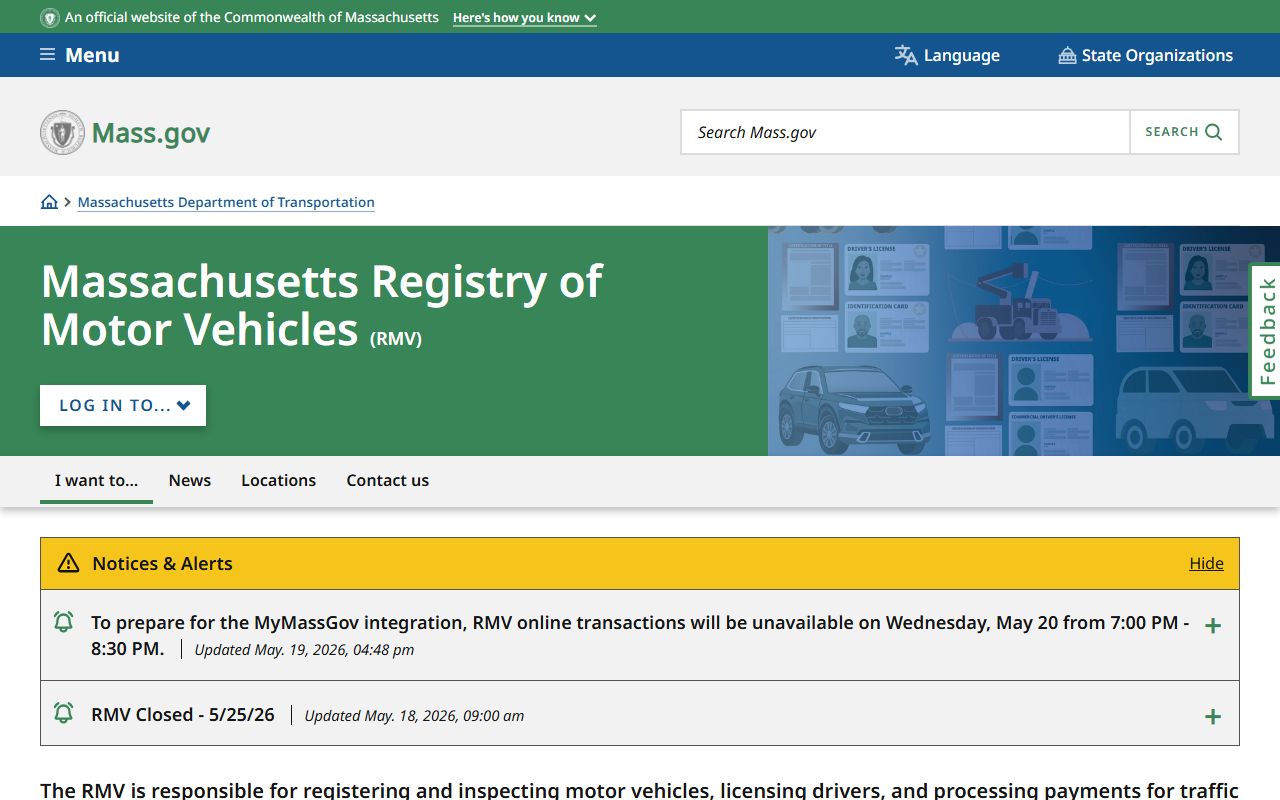
The RMV page covers driver records, suspensions, and reinstatement, none of which sit inside the court traffic file.
CDL and Commercial Driver Records
Commercial drivers face stricter rules than other drivers. A motor-vehicle case that seems minor for a regular license can carry heavier consequences for a CDL holder. Reporting and disqualification rules differ, and a finding in a Worcester County traffic case may flow into the commercial driving record kept by the state. That is why a CDL holder should treat a citation with care.
The court file still shows the citation, the finding, and the fine the same way it does for any driver. The difference shows up in the driver record and in the license consequences that can follow. A CDL holder should get legal advice before paying or contesting, since admitting responsibility can affect the commercial license. The driver-side record is requested through the RMV, not the court.
DUI and DWI Cases
OUI and DUI-type charges are criminal motor-vehicle cases, not simple tickets. They are handled in District Court, and they can also reach Superior Court when the charge is serious or repeated. These cases carry the chance of a record, a fine, license loss, and jail. Because the stakes are high, they are treated as criminal matters from the start.
A DUI or DWI case shows in the court traffic docket, but the access and sealing rules track criminal-record rules. License consequences run through the RMV in parallel. For how these charges appear, the access limits, and sealing options, see the Worcester County arrest records page, which covers criminal motor-vehicle cases in depth.
Deferred Adjudication and Defensive Driving
Drivers often ask whether a class or a deferral can keep a ticket off the record. Massachusetts does not run a Texas-style deferred adjudication for traffic cases. The court file records the citation and the finding either way. What you can do with a civil citation is pay it, contest it at a clerk-magistrate hearing, or appeal a responsible finding.
Any driver-side program, surcharge question, or course option is handled through the RMV side, not the court docket. The court record reflects what happened in the case. Changes to license status, points, and an insurance surcharge are tracked by the state, so check the RMV for those. When a course or program is offered, confirm it through the official RMV or court process rather than a third party.
Sealing or Expunging Traffic Records
Sealing is more common in Massachusetts than expungement. A criminal motor-vehicle case, such as an OUI, may be eligible for sealing after a waiting period, while many civil citations are simply court findings rather than convictions. Eligible conviction records may be sealed under G.L. c. 276, § 100A, and many nonconviction outcomes may be sealed under § 100C. Expungement is narrow and usually needs a statutory ground.
Sealing hides a record from ordinary public access; expungement erases it under limited authority. A petitioner files the right sealing petition, lists the docket numbers, and serves the required offices. Read the statutes for eligibility. You can review G.L. c. 276, § 100A and G.L. c. 276, § 100C on the state site. The arrest records page covers sealing eligibility in more detail.
Fees for Traffic Record Copies
Massachusetts does not publish one flat fee for every court copy. Charges depend on the division, the copy type, and whether you need certification. The Trial Court and each department set their own copy and certification schedules, so the clerk's office is the best place to confirm a current amount before you pay. Driver records from the RMV follow a separate fee schedule.
| Item | Fee |
|---|---|
| Plain traffic docket copy | Set by division; check the clerk or Trial Court fee schedule |
| Certified court copy | Certification fee plus a per-page charge where charged |
| Traffic citation fine | Amount set on the citation; varies by offense |
| RMV driving record | RMV fee applies; varies by record type and delivery |
The RMV driving-record request page explains the record types, delivery options, and fees on the driver side. Use the official RMV request a driving record page to order a driver record.
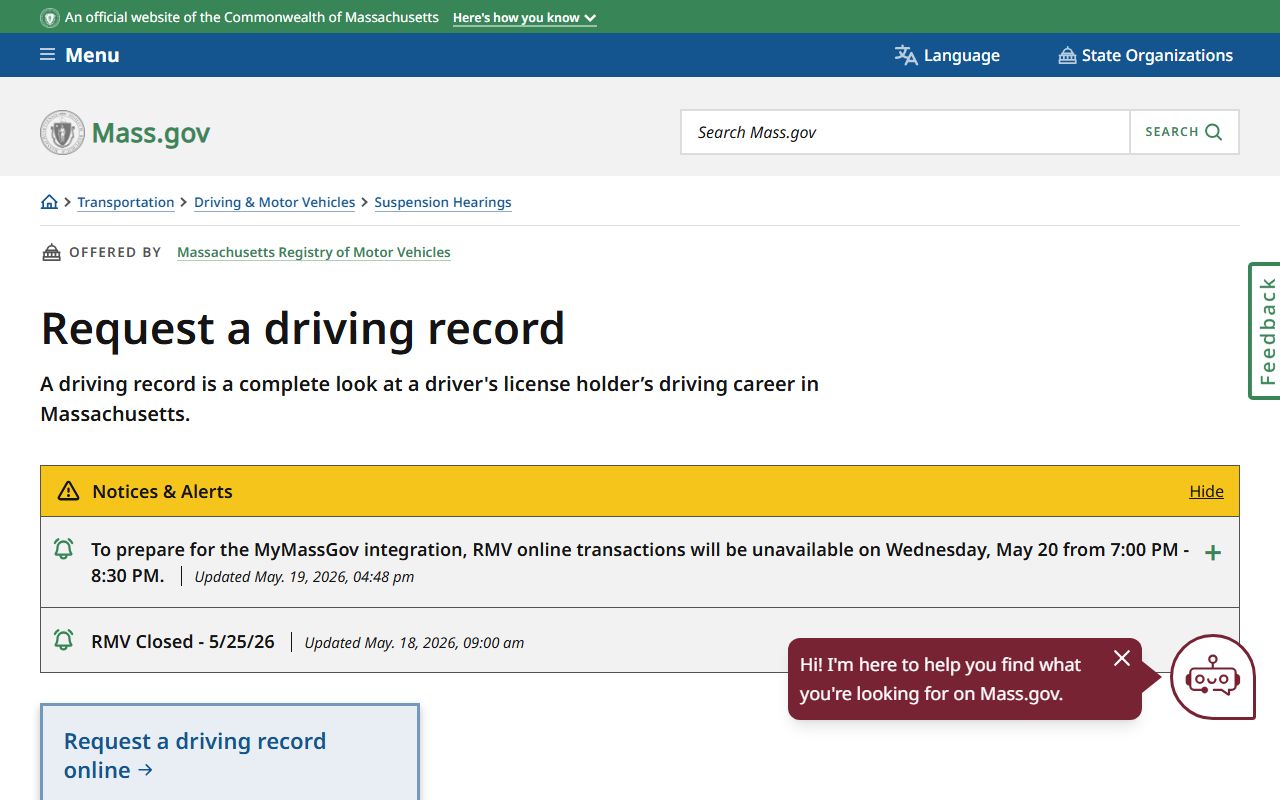
That request covers attested and unattested copies, which is the driver record and not the court traffic file. For court copy and fee help, see the Clerk of Courts page.