
How the Housing Court Fits in the Trial Court
The Housing Court is one of seven departments inside the Massachusetts Trial Court. It is a specialty court with statewide reach, split into regional divisions and sessions. Worcester County matters are heard in the Central Housing Court, which sits in the broader central region and runs a Worcester Session for cases tied to the county. The Central Housing Court also hears matters from nearby counties, but Worcester County evictions and housing-code claims belong to its Worcester docket.
The court has narrow but deep subject matter. It does not hear divorce, probate, or felony cases. It hears summary process for evictions, civil housing claims, code-enforcement actions brought by cities or towns, conditions counterclaims, receivership petitions, and small claims tied to housing. A few related side matters also sit here, such as motions to stay execution and post-judgment payment plans. The split with other Trial Court departments is set by statute and by court rules, and parties cannot simply pick which court they want.
Central Housing Court, Worcester Session
Official location page
Massachusetts Housing Court Department
Verify contacts on the location page
Hours posted on Mass.gov
Types of Cases the Court Hears
Housing Court cases all share one trait: they are about housing. Beyond that, the docket runs wider than many people expect. Some cases are filed by landlords seeking to remove a tenant. Others are filed by tenants raising conditions or retaliation claims. Cities and towns bring code-enforcement cases. And lenders, receivers, or condo associations may show up for special petitions tied to vacant or distressed property.
- Summary process complaints, also called eviction cases, for nonpayment, no-fault, or for-cause grounds.
- Landlord-tenant civil claims for security deposits, last month's rent, and lease breaches.
- Housing-code enforcement actions brought by a board of health or inspector.
- Conditions claims and counterclaims tied to habitability and the implied warranty.
- Receivership petitions to address vacant, unsafe, or abandoned property.
- Small claims tied to housing where the amount falls within the limit.
For a broader walkthrough of how to find any case file across the Trial Court, see the Worcester County court records page.
Housing Court vs District Court
One of the trickier points in Massachusetts is that the District Court can also hear some summary process cases where the Housing Court is not used. That overlap confuses tenants and landlords every week. Where Housing Court exists for the area, parties usually have a right to transfer a District Court summary process case to Housing Court. The shorthand is that Housing Court is the specialty venue, and the District Court is the general venue that picks up overflow or local matters.
Central Housing Court
- Specialty court for housing only.
- Hears summary process, code cases, and conditions claims.
- Judges and staff with deep housing focus.
- Has housing specialists and lawyer-for-a-day programs in many sessions.
- Worcester Session covers Worcester County evictions.
District Court
- General lower court with broad subject matter.
- Can hear summary process where Housing Court is not used.
- Civil, small claims, traffic, criminal, and restraining-order dockets.
- Cases may be transferred to Housing Court on request.
- Many divisions across the county, such as Worcester and Fitchburg.
For more on the District Court structure, including the local divisions, see the Worcester County District Court page. That page also lists the divisions where a summary process case might first land.
The Summary Process Timeline
Summary process is the legal name for a Massachusetts eviction case. The process is faster than a regular civil suit, which is why the law calls it summary. Even so, each step is set by rule, and skipping a step can sink a case. The basic path is the same across the state, though local scheduling can shift the dates. The list below walks the case from the first notice through the execution.
- Notice to quit. The landlord serves a written notice to quit that ends the tenancy, with the kind of notice depending on the ground.
- Summons and complaint. After the notice period runs, the landlord prepares a summons and complaint and has them served on the tenant.
- Entry at the court. The landlord enters the case at the Housing Court clerk's office and pays the entry fee.
- Tenant answer. The tenant files an answer that can raise defenses and counterclaims, often including conditions or retaliation.
- Mediation or housing specialist meeting. Many sessions try to settle the case before trial through a court mediator.
- Trial. A judge hears the case if no agreement is reached, takes testimony, and rules on the merits.
- Judgment. The court enters judgment for possession, money, or both, and sets the date the execution can issue.
- Execution. The execution is the court order that allows a constable or sheriff to move the tenant out.
- Motion to stay. The tenant can ask the court to delay the execution for hardship or other reasons set by statute.
- Move out or levy. The case ends when the tenant moves, the parties settle, or the execution is levied.
For docket-level views of any one of these steps, the Worcester County court dockets page shows how to read the event line and the next scheduled date.
Looking Up a Housing Case on MassCourts
The Trial Court's public case-search system, MassCourts, includes Housing Court dockets. A case can be found by docket number, party name, or business name. The Worcester Session shows up under the Central Housing Court division. Some events are listed by date and judge, while others show only the type of filing and the next scheduled hearing. Sealed or impounded matters are blocked from public view at the search layer.
The lead-in below points to the official Mass.gov Housing Court page. View the Massachusetts Housing Court page for department-wide details and links.
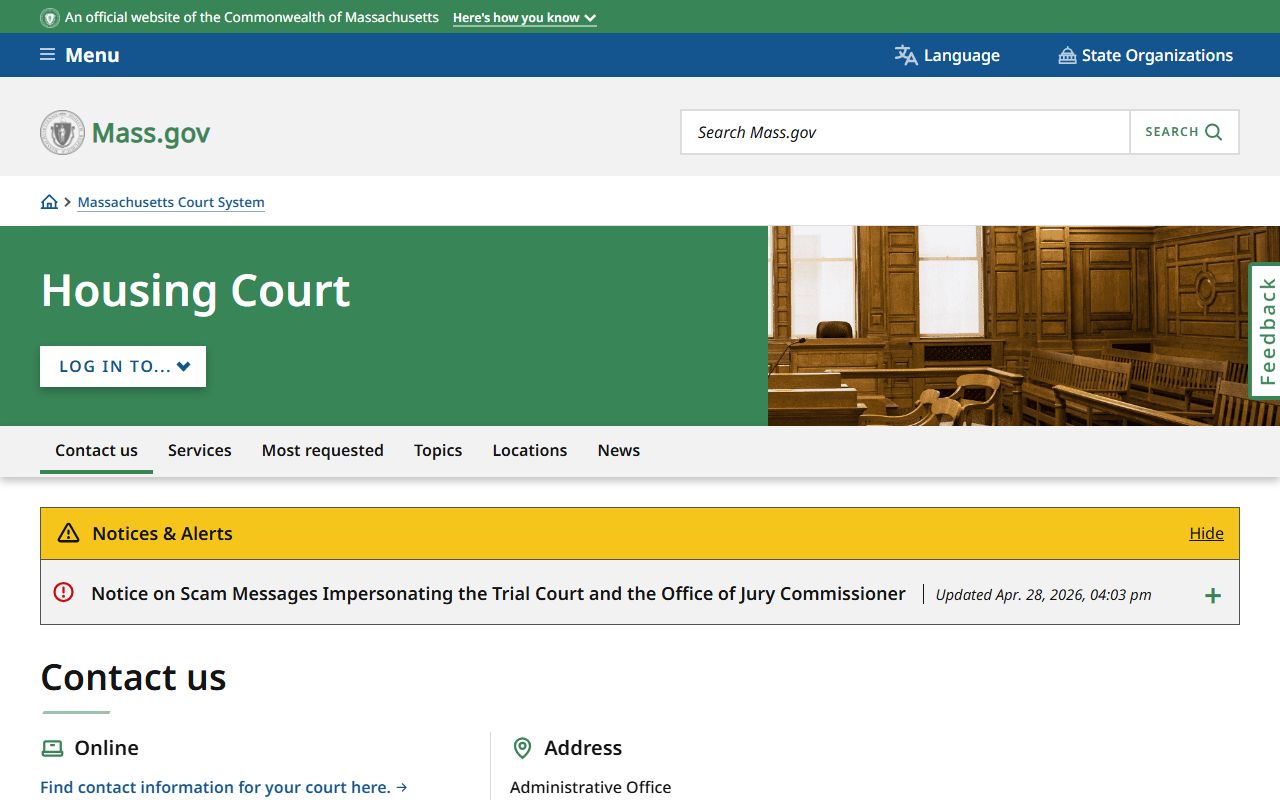
That page lays out how the Housing Court is split into divisions and sessions, with the Worcester docket sitting inside the Central division. It also links to forms and self-help resources used in most summary process cases.
Tenant Rights and Defenses
Tenants in Worcester County have a long list of statutory and common-law defenses. The implied warranty of habitability sits at the center, and a breach can support a counterclaim or a rent abatement. State law also bars retaliation against a tenant who reports a code violation or joins a tenants group. Discrimination defenses can run under state and federal fair-housing law. These defenses must be raised in the answer or they can be waived.
The answer is short but important. It lays out which facts the tenant denies, which defenses apply, and which counterclaims the tenant brings. A tenant who fails to answer can be defaulted, and a default judgment in summary process moves fast to execution. The court's lawyer-for-a-day programs help self-represented tenants draft a workable answer when one is available.
Code Enforcement and Conditions
Worcester city and town boards of health, building inspectors, and code-enforcement officers can bring cases in the Housing Court for unsafe or substandard property. These are not always eviction cases. Often the city asks the court to order repairs, to fine the owner, or to appoint a receiver who can fix the property and place a lien for the cost. Tenants can also push code claims as a counterclaim inside their own eviction case.
The court's job is to balance the owner's rights with the public-safety duty to keep housing fit. Orders can be detailed, with deadlines, re-inspection dates, and fines for missed steps. A vacant or abandoned property may end up in receivership, where a court-appointed receiver takes over the work and holds a priority lien for costs.
Filing and Copy Fees
The Trial Court sets fee schedules for each department. Housing Court fees include an entry fee on a summary process case, fees for jury claims, motion fees in some matters, copy fees, and a certification fee where the clerk certifies a copy. Fee waivers are available for parties who qualify under the affidavit of indigency rules. The table below uses verify-with-court language because each department updates its own schedule.
| Service | Office | Fee Notes |
|---|---|---|
| Summary process entry | Housing Court clerk | Set by Trial Court fee schedule; verify the current amount with the clerk's office. |
| Jury claim | Housing Court clerk | Amount and timing rules apply; confirm with the clerk before filing. |
| Motion fees | Housing Court clerk | Some motions carry a fee; many do not. Check the schedule. |
| Plain copies | Housing Court clerk | Per-page fee; ask the clerk's office for the current rate. |
| Certified copies | Housing Court clerk | Certification fee on top of copy charges; verify before payment. |
| Indigency waiver | Housing Court clerk | File an affidavit of indigency to request a fee waiver under the rules. |
Note: Confirm the current filing, copy, and certification fees with the Housing Court clerk before sending payment. The Trial Court updates its fee schedule, and Housing Court rates can shift with those updates.
Motions to Stay and Post-Judgment Relief
After a judgment for possession, the case is not always over. A tenant can ask the court to stay the execution for hardship, illness, or to give time to find a new place. The judge weighs the request against the landlord's right to possession and any rent that is owed. Stays are common but not automatic, and the tenant usually must keep paying use and occupancy during the stay.
The court can also handle agreements for judgment after the case is over. Many cases settle on terms that require payment over time or repairs by a fixed date. If a party breaks the agreement, the other side can ask the court to enforce it or to issue the execution. These post-judgment paths keep the case open even after the trial date has passed.
Public Access and Impoundment
The Housing Court docket is generally public. Names, case numbers, hearing dates, and most filings can be searched online. Yet some files are impounded by court order or by statute, and some sensitive matters move outside the public view. Examples include cases tied to abuse-prevention orders that touch on housing, cases with minors as parties in narrow circumstances, and any file the court has sealed for cause.
The lead-in below points to the Central Housing Court Worcester Session location page. Use the Central Housing Court Worcester Session page for the official contacts.
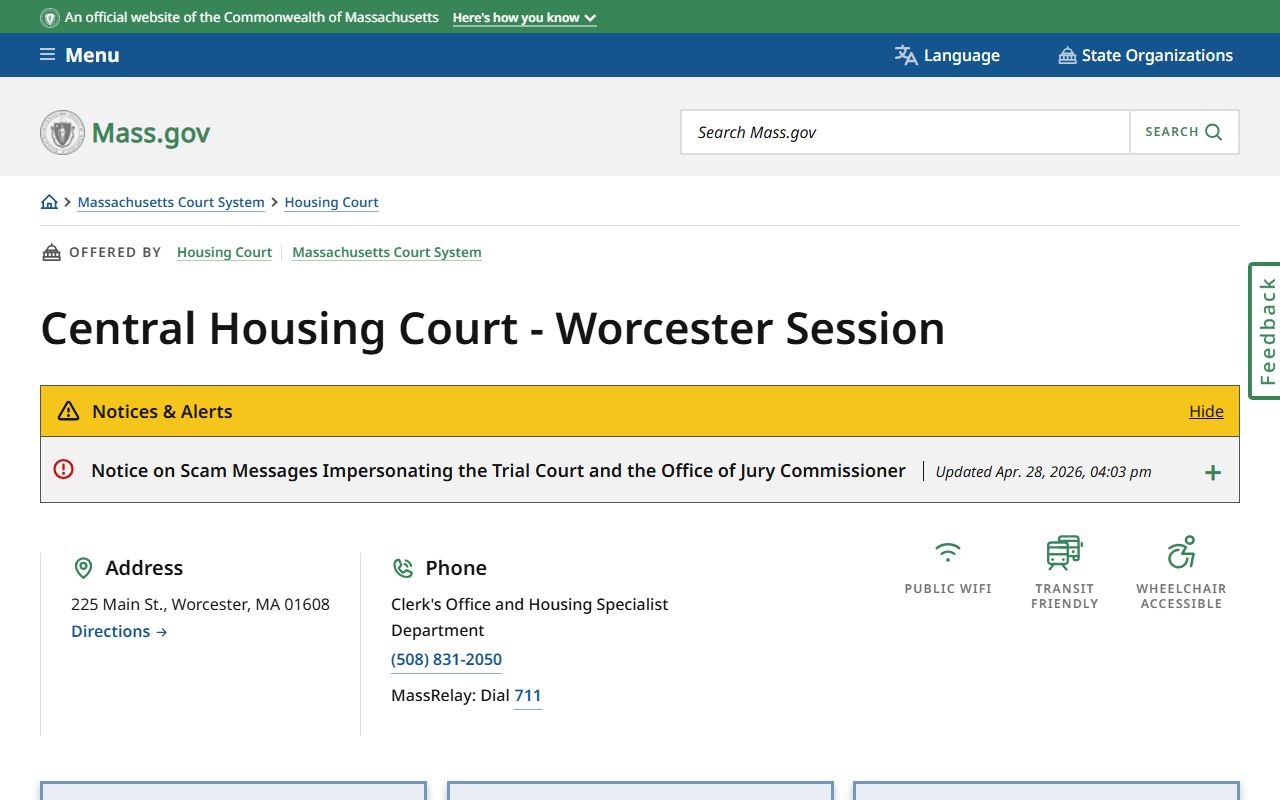
That page is the official source for the Worcester Session's hours, address, and clerk contacts. For a deeper look at the Public Records Law and which agency records sit outside the court system, see the Worcester County public records page.
Housing Court Terms to Know
Housing Court has its own vocabulary, and a few words trip up first-time filers. The list below is short, but each term shapes the case. Knowing the difference between a notice to quit and a summons, or between an execution and a stay, can change what a party does next.
- Summary process
- The fast-track court procedure used for evictions in Massachusetts. It sets short deadlines and limited pretrial steps.
- Execution
- The court order that allows a constable or sheriff to physically remove a tenant after judgment for possession.
- Stay of execution
- A court order that delays the execution for a set period, often for hardship reasons set by statute.
- Escrow
- Money paid into a court or third-party account while a case is pending, often used for rent during a conditions claim.
- Receivership
- A court process where a receiver is appointed to take over and repair an unsafe or distressed property.
- Code enforcement
- A case brought by a city or town to make an owner fix code violations, often with fines and re-inspection dates.