
Getting a Marriage License in Worcester County
Marriage in Massachusetts runs through city and town clerks, not the Worcester County court. There is no county marriage office. To get married in Worcester, a couple files a marriage intention with the Worcester City Clerk. People marrying in another town in the county use that town's local clerk instead. The clerk takes the intention, checks the rules, collects the local fee, and issues the license once the waiting period passes. The state explains the full path on its official marriage license page, and each clerk applies the same statewide steps with small local twists.
Both parties usually file the intention in person. The clerk asks for legal names, birth details, current address, and information about any prior marriage. A photo ID is standard. Massachusetts sets a three-day waiting period between filing the intention and getting the license, though a judge can waive it for good cause. The license is valid for sixty days, and the marriage can take place anywhere in the state during that window. After the ceremony, the officiant signs the license and returns it to the issuing clerk for recording.
Age rules matter here. Adults eighteen or older file on their own. A minor needs both parental consent and court approval, which is rare. Confirm the current local fee with your clerk before you go, since each city and town sets its own.
How to Apply for a Marriage License
The process is short once you know the order of the steps. Most clerks let you start online or by phone, but the intention itself is filed in person in most towns. Bring everything in one trip so you do not have to come back.
- Pick the right clerk. Couples marrying in Worcester use the Worcester City Clerk; other towns use their own local clerk.
- Both parties go to the clerk's office and file a marriage intention in person, unless a local or state exception applies.
- Give legal names, birth information, current address, any prior marriage details, and valid photo identification.
- Pay the local marriage license fee set by that city or town.
- Wait the three-day statutory period unless a court waiver has been granted.
- Pick up the license and have the ceremony performed by an authorized officiant within the validity window.
- The officiant returns the signed license to the issuing clerk for recording, and certified copies can then be ordered.
Once the license is recorded, the clerk holds the official marriage record. That clerk, or the state Registry of Vital Records and Statistics, is where you order certified marriage certificates later.
Marriage License Application Fields
The marriage intention form asks each person for the same core set of facts. Filling it out goes faster when you have the details ready, especially birth information and anything about a past marriage. The table below lists the main fields a Worcester County clerk collects on the application.
| Field | Required | Notes |
|---|---|---|
| Full Legal Name | Yes | Both parties; current legal name as it appears on ID. |
| Date and Place of Birth | Yes | Birth information for each party. |
| Current Address | Yes | Residence of each party. |
| Prior Marriages | Yes | How a prior marriage ended, such as divorce or death. |
| Photo Identification | Yes | Valid government ID for each party. |
| Parental Consent / Court Approval | Conditional | Required only when a party is a minor. |
Each clerk may add a line or two of its own, but these fields cover what the state asks for on a marriage intention. The official mass.gov how-to walks through the same items.
Worcester County Marriage and Divorce Fees
Massachusetts does not set one flat fee that covers every marriage and divorce service. The marriage license fee is set by each city or town clerk, so it changes from place to place. Divorce filing and copy fees are set by the Probate and Family Court. None of these amounts are published as a single fixed figure for the county, so the safest move is to confirm the current charge with the office before you pay.
| Item | Amount |
|---|---|
| Marriage license | Set by each city or town clerk; verify with the local clerk |
| Certified marriage certificate copy | Set by the issuing clerk or the Registry of Vital Records; verify current fee |
| Divorce filing | Set by the Probate and Family Court; verify current fee schedule |
| Certified divorce decree copy | Certification and copy fees apply; verify with the court |
Fee waivers exist for people who cannot afford to pay. A party who files an affidavit of indigency may have divorce filing fees waived by the court. Ask the clerk how to file that affidavit when you submit your case.
How to Look Up Worcester County Marriage Records
Marriage records are not in the court case system. They sit with the clerk of the city or town where the intention was filed, and with the state Registry of Vital Records and Statistics. To find a Worcester marriage record, start with the Worcester City Clerk if the couple filed there, or the local town clerk for a marriage in another part of the county. The state registry holds copies for marriages across Massachusetts and can fill orders when you do not know the exact town.
You will need a few facts to pull the right record. The full names of both parties help most, including a maiden name where it applies. The date or year of the marriage narrows the search. The town where the license was issued points the clerk straight to the file. With those details, the clerk or registry can locate the record and prepare a certified copy. The state runs an official online order path for vital records, which covers birth, marriage, and death certificates in one place.
The mass.gov how-to for ordering a birth, marriage, or death certificate lays out the online and mail options. You can review the steps on the official mass.gov order a vital record page before you start.
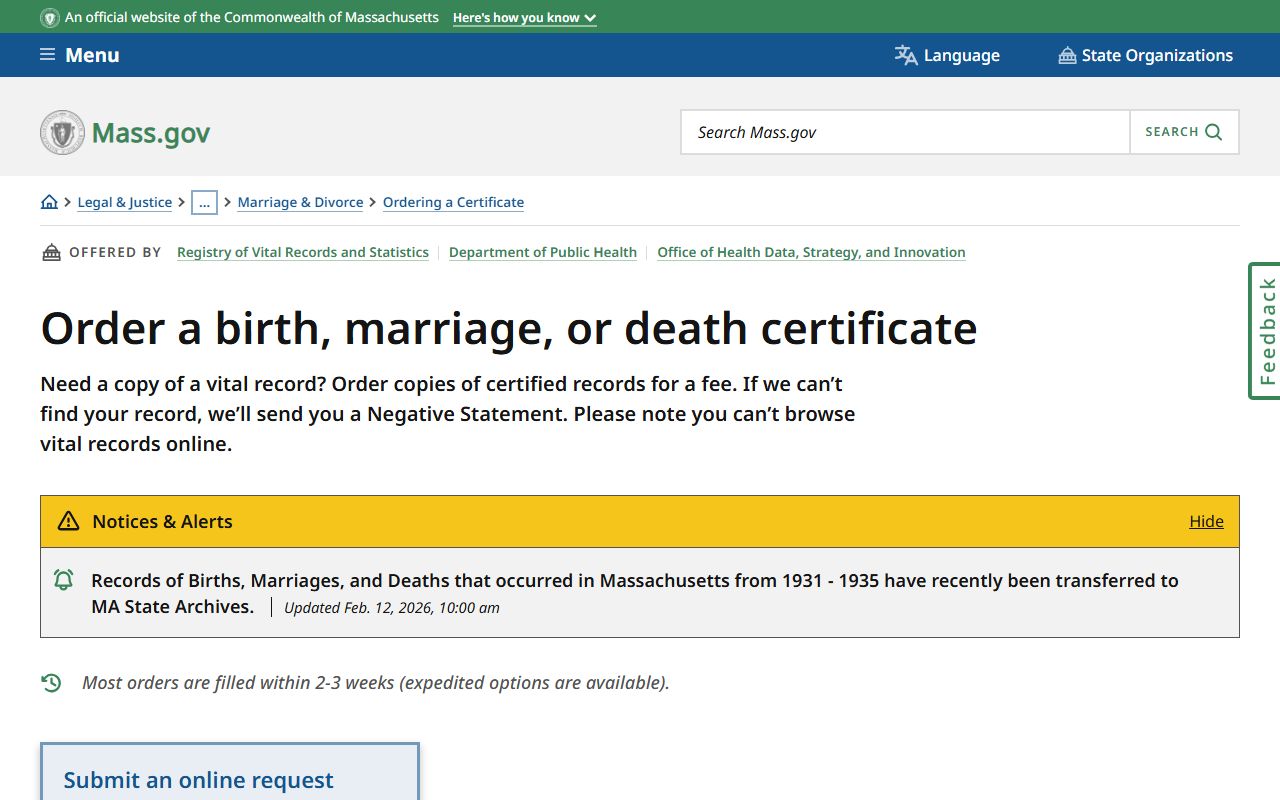
The same page shows the fees, processing times, and the registry contact you use when the local clerk does not hold the marriage record you want.
How to Find Worcester County Divorce Records
Divorce records are court records, and in Worcester County they belong to the Worcester Probate and Family Court at 225 Main Street, Worcester, MA 01608. That is a key difference from marriage records. While marriage licenses come from town clerks, a divorce is a court case with a docket, parties, and a judgment. You search divorce cases through the same Probate and Family Court department, by docket number when you have one or by party name when you do not. The court division for a county divorce is the Worcester Probate and Family Court.
The fields used to search a divorce record are listed below. A docket number gives the cleanest result. When you only have names, current and maiden names may both be needed, and the filing year helps narrow a common name.
| Field Label | Required | Notes |
|---|---|---|
| Docket number | Optional but best | Probate docket number for the case. |
| Party names | Yes if no docket | Current and maiden names may be needed. |
| Court division | Yes | Worcester Probate and Family Court. |
| Divorce year or date | Optional | Narrows the search. |
| Copy type | Yes | Plain, certified, or certificate. |
Not every part of a divorce file is open to the public. Docket entries and the judgment may be public, but financial statements, child custody details, abuse-prevention information, impounded records, and personal identifiers can be restricted by statute or court order. A judge can impound a whole file when safety or privacy is at stake.
How to File for Divorce in Worcester County
A Worcester County divorce is filed in the Worcester Probate and Family Court. Massachusetts offers two main paths. A joint petition under section 1A is for couples who agree on everything and file together with a written agreement. A complaint under section 1B, or a fault-based complaint, is for cases where the parties do not agree. The steps below outline how a divorce case moves from filing to final judgment.
- Confirm jurisdiction and the residency rules apply to your case.
- Choose the divorce type: a joint petition under section 1A, or a complaint under section 1B or fault grounds.
- Prepare the complaint or petition, a certified marriage certificate, financial statements, any child-related forms, a separation agreement for a joint filing, and a fee-waiver affidavit if you cannot afford the fee.
- File the case with the Worcester Probate and Family Court.
- Serve the other party if the case is contested.
- Attend case-management, motion, pretrial, or hearing dates as scheduled.
- The court enters a judgment of divorce nisi, which becomes absolute after the statutory waiting period.
The judgment nisi is not the end on day one. It becomes final only after the waiting period set by statute runs out. Until then the marriage is not fully dissolved, so timing matters for things like remarriage.
Getting Certified Copies
A plain printout is fine for personal reference, but many uses need a certified copy. A certified copy carries the seal of the clerk or court and is accepted as proof. You will need certified copies for things like changing a name on a passport, claiming a benefit, settling an estate, or proving a divorce is final before remarriage. An uncertified result from an online search does not carry that legal weight.
Where you order depends on the record. For a marriage certificate, ask the city or town clerk that issued the license, or the state Registry of Vital Records and Statistics. For a divorce record or decree, ask the Worcester Probate and Family Court, or use the state's official divorce-copy path. Processing time varies by office and by how you order, so order well ahead of any deadline.
The mass.gov how-to for getting a copy of a divorce record explains who can request one and how. Start with the official mass.gov divorce record copy page for the current steps.
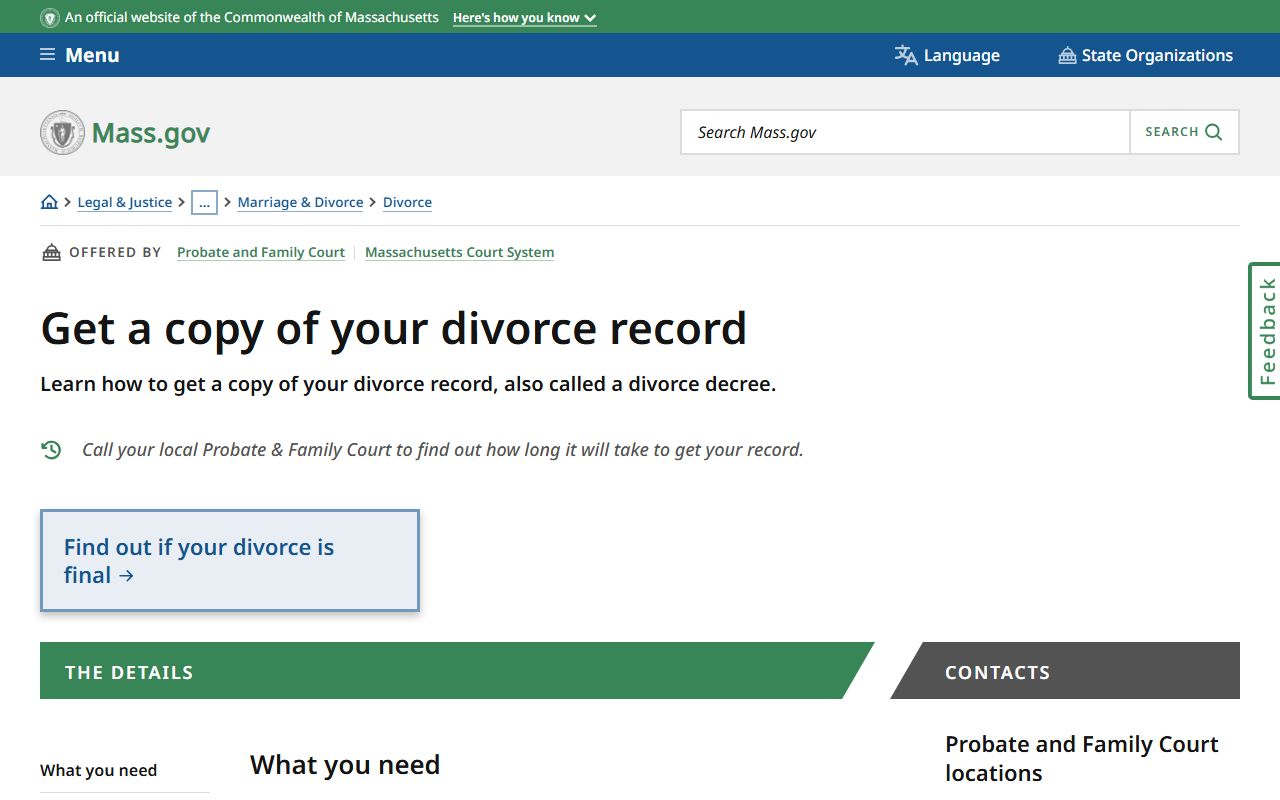
The page also notes which divorce documents are restricted, which helps set expectations before you submit a request for a sensitive file.
Restricted Marriage and Divorce Records
Some details in these records are protected, even when the case itself is public. In a divorce file, financial statements and account numbers are sensitive. Child custody and child-support information can be limited. Abuse-prevention orders and the information tied to them are guarded for safety. A judge can impound part or all of a file, which keeps it off the public docket. Personal identifiers like Social Security numbers are masked.
Marriage records are more open, but certified copies are still controlled. The clerk or registry checks who may receive a copy and how. When part of a record is impounded, even a person with a clear interest may need a court order to see it.
Note: Financial statements, custody details, and impounded portions of a divorce file may be sealed, so confirm access with the court before you rely on a public docket entry.
Massachusetts Vital Records Office
The Registry of Vital Records and Statistics is the statewide office for birth, marriage, and death certificates. It holds marriage records from across Massachusetts and can fill orders when you do not know the issuing town or when the local clerk no longer holds the record. The registry runs the state online order path and also takes mail and in-person requests. It is the state backstop for any Worcester County marriage certificate you cannot get locally.
Registry of Vital Records and Statistics
Massachusetts Department of Public Health
Massachusetts, MA
Birth, marriage, and death certificates
For divorce decrees, the registry is not the source. Those stay with the Worcester Probate and Family Court, so use the court or the state divorce-copy path for any divorce document.