
Arrest Records in Worcester County
A Worcester County arrest record is created at the point of booking. When a local police department, the state police, or the Worcester County Sheriff's Office takes someone into custody, staff log the arrest and start a file. That file holds basic booking data: the name of the person, the date and time, the agency that made the arrest, and the charge listed at the time. A booking photo, often called a mugshot, is taken during intake. The arrest record is a law-enforcement record, so it lives with the police or the sheriff, not with a court clerk.
This is the key split to keep in mind. An arrest record is not the same thing as a criminal court record, and neither one is a conviction. The arrest is the first event. If the case moves forward, charges get filed and a separate court file opens in District Court or Superior Court. That court file tracks pleas, motions, hearings, and the final result. Full case history is covered on the Worcester County court records page. This page stays focused on the arrest side: booking, the jail roster, mugshots, and how to find a recent arrest.
How to Search Worcester County Arrest Records
There is no single statewide arrest log in Massachusetts. To find a recent Worcester County arrest, you usually start with the agency that holds the person. The Worcester County Sheriff's Office runs the county Jail and House of Correction and posts a public inmate look-up. If someone was just arrested and booked into the county jail, that roster is the fastest check. Local police departments also keep arrest logs and daily blotters, and some publish them. For the formal criminal history, the state runs a separate request system.
- Start with the Worcester County Sheriff inmate look-up to see if the person is in county custody.
- Search by first name, last name, or inmate number, then open the result row for booking detail.
- Check the arresting town's police department for an arrest log or blotter if the person is not in the jail.
- For an official criminal history, request a CORI report through the state, not the local agency.
Use the official Worcester County Sheriff's inmate search at inmatesearch.wcsoma.org to confirm a county booking. The sheriff's main site is worcestercountysheriff.com. For a deeper walkthrough of the roster, its fields, and visitation rules, see the Worcester County inmate records page. The jail holds pretrial detainees and people serving county sentences, which is separate from the state prisons run by the Massachusetts Department of Correction.
Arrest Records vs. Criminal Court Records
People mix these two up all the time, and the difference matters. An arrest happens at booking and is logged by police or the sheriff. A criminal court record only starts once charges are filed and a case opens with the court clerk. One arrest can lead to a court case, no case at all, or several charges that resolve in different ways. So an arrest record tells you a person was taken in. It does not tell you what the court did, or whether a court got involved at all.
| Arrest Record | Criminal Court Record | |
|---|---|---|
| Source | Police or Worcester County Sheriff | Trial Court clerk's office |
| Created When | At booking, when custody starts | When charges are filed in court |
| Contents | Booking data, charge at arrest, mugshot | Complaints, pleas, motions, disposition |
| Where to Find It | Sheriff roster or police blotter | MassCourts and the clerk's office |
For the full court file, including dockets, hearings, and the final outcome, the court records page walks through MassCourts and the clerk request process. Treat the arrest record as the starting point, then follow the charge into the court system if you need the result.
Charges vs. Convictions
An arrest involves a charge, and a charge is only an accusation. It is not proof of guilt. To bring a charge, police need probable cause, a fairly low bar. To win a conviction, the Commonwealth must prove the case beyond a reasonable doubt, a much higher bar. Many charges never become convictions. A case can be dismissed, a person can be found not guilty, or the grand jury can decline to indict. The arrest still shows in the record even when the charge falls apart later.
| Charge | Conviction | |
|---|---|---|
| Stage | Accusation at or after arrest | Verdict or guilty plea |
| Burden of Proof | Probable cause | Beyond a reasonable doubt |
| Decided By | Police or prosecutor | Judge or jury |
| Final Outcome | Not yet decided | Case resolved against the defendant |
Always read the disposition before you draw a conclusion. The Worcester County District Attorney's Office, led by Joseph D. Early Jr., prosecutes these cases and decides which charges to pursue. You can learn more about the office at worcesterda.com. Someone arrested and charged may walk out with no conviction at all.
Sealed vs. Expunged Records
Massachusetts uses sealing far more often than expungement, and the two are not the same. Sealing hides a record from ordinary public view, but the file still exists and limited parties can reach it. Expungement is stronger and rarer. It destroys or erases the record so it is treated as if it never happened. Most people who want to clean up an old arrest or case end up in the sealing track, because expungement needs a narrow statutory ground.
| Sealed | Expunged | |
|---|---|---|
| Visibility | Hidden from public view | Destroyed or erased |
| Record Still Exists | Yes, with limited access | No, treated as never existed |
| Law Enforcement Access | Limited | Very limited |
| Eligibility | Waiting period under Massachusetts General Laws c. 276, § 100A and § 100C | Narrow grounds such as identity theft or clear error |
Eligible convictions may be sealed after a waiting period under Massachusetts General Laws c. 276, § 100A, which the Commissioner of Probation handles. Nonconviction outcomes, such as a dismissal or a not-guilty finding, can be sealed under Massachusetts General Laws c. 276, § 100C.
The sealing statute for nonconviction outcomes lays out which results qualify and how a petition proceeds.
The screenshot below shows the official text of the section 100C sealing provision on the state legislature site.
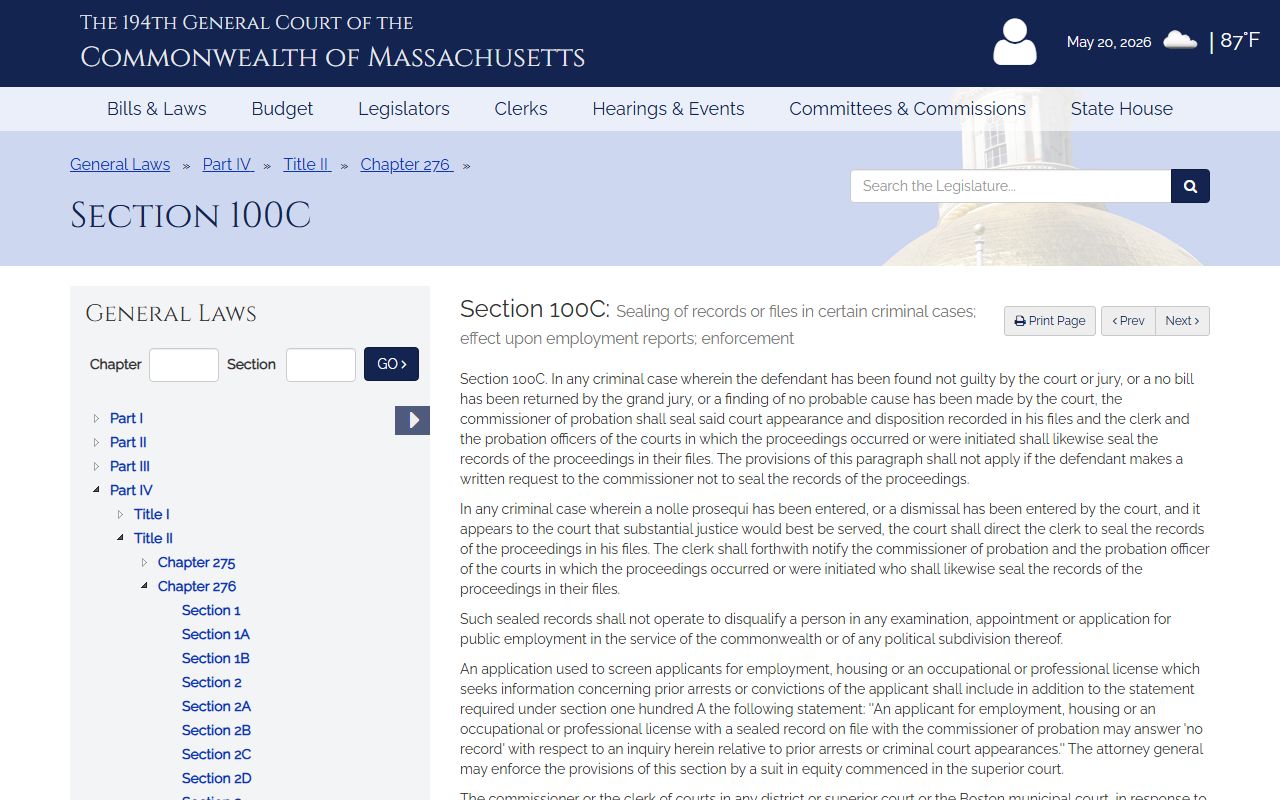
Reading the statute directly helps a petitioner check waiting periods and exclusions before filing a sealing request tied to a Worcester County arrest.
Mugshots and Booking Photos
A booking photo, the mugshot, is taken during jail intake. The Worcester County Sheriff's Office shoots one as part of the booking process when a person enters the county Jail and House of Correction. Mugshots are part of the arrest and booking record. Whether the public can see a given photo depends on agency policy and on any restriction tied to the case, such as a sealed file or a protected category. The county inmate look-up table shows core identifiers, but it does not promise a photo for every entry.
Be careful with private mugshot sites. Many third-party sites repost booking photos and then charge to remove them. Those sites are not official, are often out of date, and can keep an old photo up long after a case is dismissed or sealed. Stick to the sheriff's own look-up or the arresting agency for accurate booking information. A photo on a private site is not proof of a current charge or any conviction.
CORI and Criminal Offender Record Information
In Massachusetts, the official criminal history is called CORI, short for criminal offender record information. CORI is a state-run system, and it is separate from the public court docket and from any single arrest log. It pulls together a person's adult criminal court activity across the state into one report. Access to CORI is controlled by law. Not everyone can pull a full report, and what a requester sees depends on their access level.
The rules on who may get CORI and how it can be shared come from Massachusetts General Laws c. 6, § 172. Employers, landlords, and the general public each get different levels of access, and sealed records under c. 276 do not show up in a standard CORI result. Requests run through the state, not through the Worcester County Sheriff or a local clerk.
The CORI access statute is what governs who can see a person's criminal history report.
The image below shows the section 172 CORI dissemination statute on the official Massachusetts legislature website.
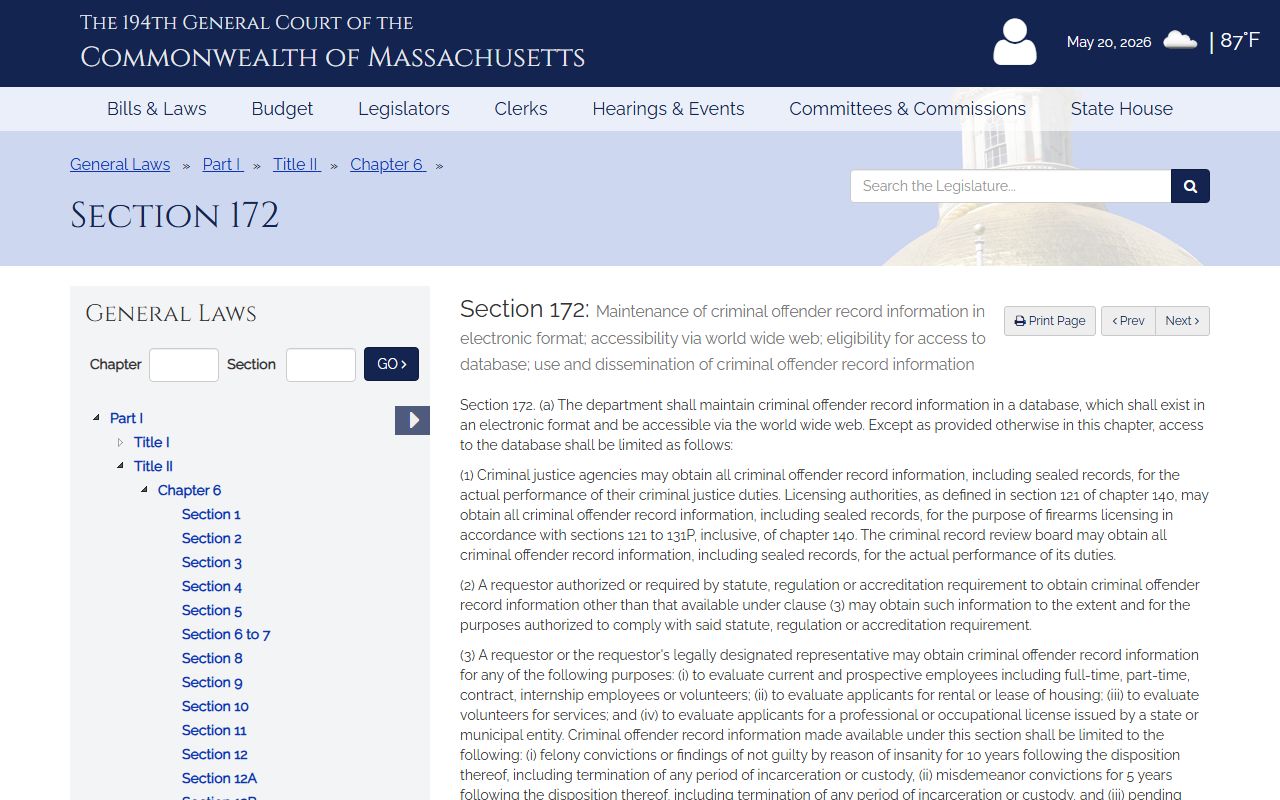
Reading the CORI statute makes clear why an arrest log and an official criminal history are not the same source, and why each has its own access limits.
Statewide Criminal Records Search
For a formal criminal history rather than a single arrest, the request goes to the state. CORI reports are managed at the state level under Massachusetts public-access and CORI rules, and the access framework sits across several statutes. The Public Records Law covers many sheriff and agency records, while court case files follow a separate set of Trial Court rules. So a booking-policy request to the sheriff and a certified criminal docket request to a court clerk travel two different roads.
The 100A sealing provision is the other half of the CORI picture, since sealed convictions drop out of standard reports.
The screenshot shows the section 100A sealing statute, which sets the waiting periods for sealing eligible convictions.
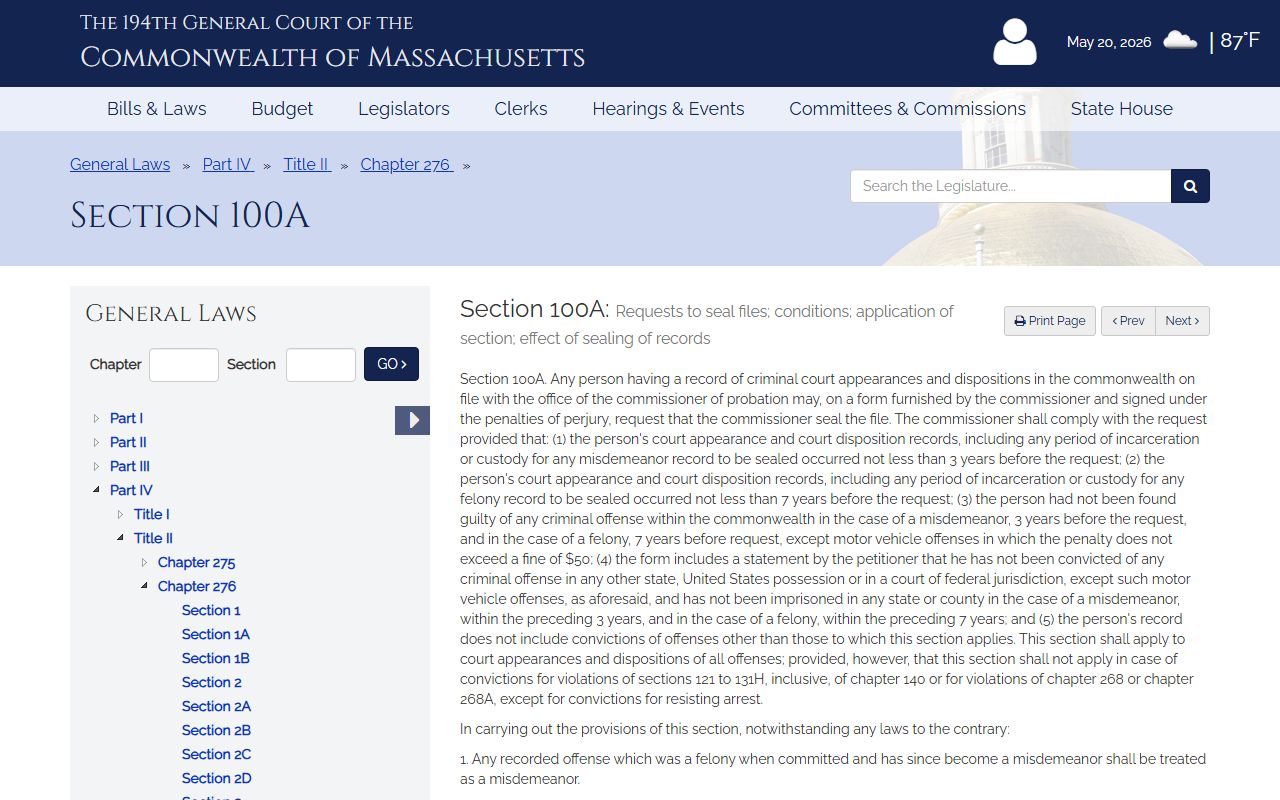
Together with section 100C and the CORI statute, section 100A explains why an old Worcester County arrest may no longer appear in a routine background search.
Background Check Considerations
There is a real gap between a casual name lookup and a regulated background check. A formal background check for hiring, housing, or credit must follow the federal Fair Credit Reporting Act, the FCRA. That law sets rules on accuracy, consent, and how a person can dispute bad data. CORI access for employers and landlords runs under the state CORI rules as well. A quick search of an arrest log or a jail roster is not a compliant background check, and it should never be used as one.
Important: This site is not a consumer reporting agency under the FCRA, and arrest data here may not be used for employment, tenant, credit, or insurance screening.
Prosecution and Defense in Worcester County
Once an arrest leads to charges, two sides shape what happens next. The Worcester County District Attorney's Office prosecutes criminal cases, works with police agencies, and supports victims and witnesses. The current District Attorney is Joseph D. Early Jr. On the other side, people who cannot afford a lawyer may get court-appointed counsel. Massachusetts handles indigent defense through the Committee for Public Counsel Services, known as CPCS.
CPCS provides representation through staff public defenders and private bar advocates for eligible defendants in criminal and certain other matters. A person usually requests counsel at arraignment or through the court. You can read about indigent defense at the CPCS site. For victim and witness help, the DA's office maintains resources at worcesterda.com/victim-witness.
The CPCS site explains who qualifies for a court-appointed lawyer and how the request works.
The image below shows the public-facing page for the Committee for Public Counsel Services.

Knowing both the prosecution and the defense side helps make sense of how a Worcester County arrest moves from booking toward a final court result.
Restricted Criminal Records in Worcester County
Not every arrest or criminal record is open to the public. Massachusetts keeps several categories out of ordinary view. Knowing what is blocked saves time and sets the right expectation before you search.
- Juvenile records, with access limited by statute and Trial Court rule.
- Sealed criminal records under c. 276, §§ 100A and 100C.
- Expunged records, which are erased under narrow grounds.
- Grand-jury material, which stays secret until an indictment is returned.
- Victim-identifying details in abuse, domestic violence, and sexual-assault cases.
- Open investigatory records, where release could harm an active case.
An indictment becomes public once it is returned and the defendant is arraigned, unless a judge impounds it. Social Security numbers, financial-account numbers, and minor names are redacted from public files. For how restricted categories are handled across all court files, the court records page covers the broader access framework.
Note: Sealed and expunged Worcester County arrest records will not show in a standard public search, so a clean result does not always mean a person was never arrested.